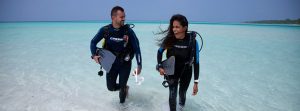
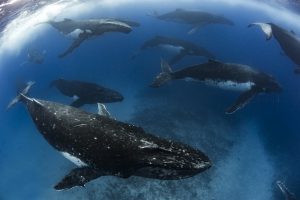
Before you see anything, you hear them. As the panga approaches the rocks, the colony has already noticed your arrival: barking from every direction, dark bodies slipping into the water, and the occasional juvenile leaping in before you’ve even finished adjusting your regulator. The sea lions of Baja California Sur don’t wait for you to find them. They find you.
If you’d rather experience it from the surface, our guide to snorkeling with sea lions covers the basics. Here, we’ll focus on what matters when you dive with a tank: how they behave, how to move among them, why the colony’s seasonal calendar matters, and where else you might encounter them in the region.
Scuba diving is a different kind of encounter
Young sea lions have one particular obsession: bubbles.
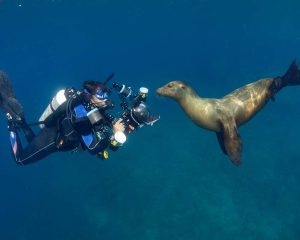
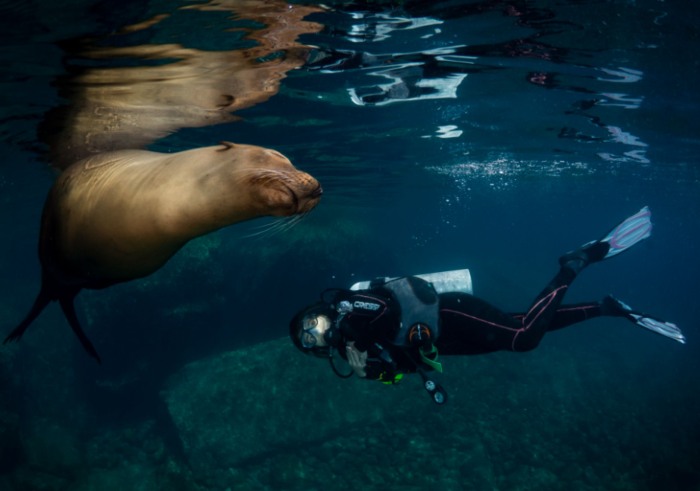
To them, a diver breathing underwater is a source of entertainment. That’s why you’ll see them dive in as soon as the boat approaches, then circle around your regulator as though it were a toy.
With scuba gear, you’re in their playground for the entire dive, and at depths of 5–15 meters, the encounter lasts longer. Even so, it’s not what most visitors do. A CIBNOR study on the carrying capacity of Los Islotes recorded around 3,900 scuba divers between March 2014 and February 2015, compared with more than 15,000 snorkelers. The figures are a few years old, but they give a good sense of the proportions: for every scuba diver, almost four people stayed at the surface.
Who’s who in the colony
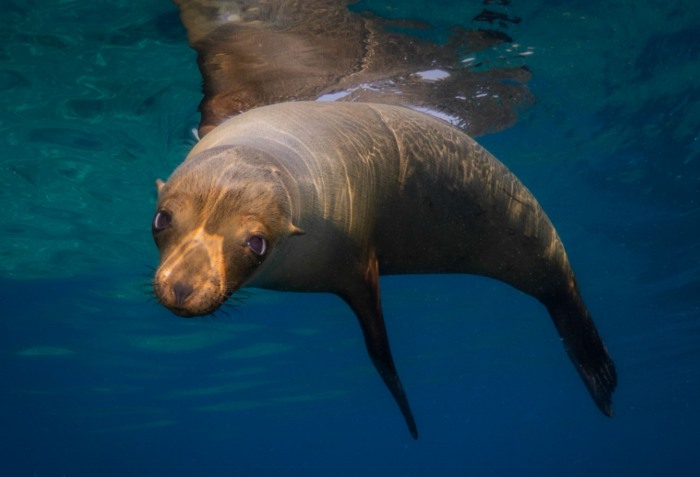
The California sea lion (Zalophus californianus) is the only pinniped species living in the Gulf of California, which has 13 breeding colonies.
Los Islotes, north of Espíritu Santo Island, is the southernmost of them all, and CONANP estimates its population at around 550 individuals. The species is listed as subject to special protection under Mexican regulations.
Not every sea lion in the colony behaves the same way, and it’s worth learning to tell them apart from the very first minute:
- Dominant males. They control a group of females and defend their territory against other males. They’re larger and highly territorial.
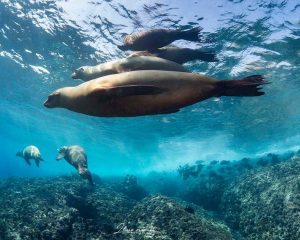
- Females and pups. They form their own subgroups within the colony and are often the ones that approach divers.
- Juveniles. The most playful of the bunch. They’re the ones that nibble at your fins, tug on your mask straps, and investigate your wetsuit as if it were a tug toy.
How to read their body language
A juvenile nibbling your fin isn’t attacking you: it’s playing. It’s part of their usual behavior, and several may approach you at once.
With males, the signals are different. When a diver enters a male’s territory, he gives warnings in stages: first, he swims past nearby without approaching you directly; if you keep moving forward, he starts coming at you head-on, barking and blowing bubbles. This isn’t an attack; it’s a warning, and the right response is to back away calmly, without suddenly turning your back or getting between him and his females. Males are the least tolerant of human proximity, and they’re the ones that set the boundaries.
Technique: how to dive with sea lions
Some things come naturally to any reasonably experienced diver, while others can only be learned in this colony:
- Neutral buoyancy and staying near the bottom. Keep your distance from the rocks and leave that space to the colony. If you get too close, you’re entering the very area where they rest and defend themselves.
- Let them come to you. Your bubbles do the work of attracting them. Chasing them doesn’t work (they’re much faster than you), and park rules prohibit harassing or touching the animals. Feeding them is completely out of the question.
- Slow movements and steady breathing. Sudden movements don’t help; staying calm does.
- Secure your gear. Tighten your mask strap and secure your alternate air source and pressure gauge. Anything dangling could become a toy.
- Monitor your air and dive computer. It’s easy to lose track of time when five sea lions are swimming circles around you.
- Have your camera ready. Fully charged batteries and patience are essential: the animals move in and out of the frame in a second, and the light in shallow water is a big help.
Park regulations limit group sizes to one authorized guide for every six certified divers and prohibit touching marine life. Following these rules isn’t just a formality: it’s what allows the colony to continue tolerating divers.
The colony’s calendar: why diving isn’t allowed in certain months
Here’s something many travelers don’t know: the colony’s breeding cycle determines when diving with the sea lions is possible.
Pups are born between late May and July. Each female gives birth to a single pup after around nine months of gestation, and a newborn measures about 70 centimeters. Nursing continues for months or even years, so the colony always has young sea lions of different ages.
During the summer, when males are actively defending their territories, interactions with humans become riskier. That’s why CONANP and Semarnat restrict swimming, snorkeling, and scuba diving at Los Islotes every year from June 1 to August 31 as a protective measure.
There are plenty of opportunities during the rest of the year. From September to May, you’ll encounter playful juveniles and females, which is exactly what makes this dive so special. Bear in mind that hurricane season can also reduce the number of days boats can go out in August and September.
Beyond Los Islotes
Sea lions can also be found at other sites in the region, each offering a different kind of encounter:
- San Rafaelito. This is a rocky outcrop topped by a lighthouse in La Paz Bay, within the Balandra Flora and Fauna Protection Area. According to a UABCS study, it isn’t a breeding colony but a resting site, home mainly to juvenile males and non-breeding adult males. CONANP rules require visitors to stay at least five meters away from the rocks. Dives range from 5 to 25 meters deep, with corals and Pacific fish below.
- Swanee Reef. South of Espíritu Santo, at around 10 meters deep. Large schools of fish attract sea lions and birds, making it a favorite spot for underwater photographers.
- Magdalena Bay and the sardine run. On the Pacific coast, about three hours by car from La Paz, Magdalena Bay is the most important sardine sanctuary in the North Pacific. Every autumn, between October and December, usually peaking in November, sardines gather in enormous bait balls and predators arrive to feed: striped marlin, birds, and sea lions too. Here, you’ll see a different side of them: they aren’t playing, they’re hunting.
One important distinction: this spectacle is experienced by snorkeling and freediving, not scuba diving. Entering the water this way lets you move quickly and follow the action throughout the day as the bait balls form and break apart.
Protecting the colony, and how you can help
The recent history of the Los Islotes colony has a darker side too: sea lions becoming entangled in fishing nets and lines. CONANP, together with PROFEPA, Semar, and local organizations, organized disentanglement efforts, and the percentage of entangled animals in this colony fell from 10% in 2014 to 1% in 2017. It’s one of those cases where coordinated action makes a difference.
Your part as a diver may be small, but it matters:
- Tell your guide if you see a sea lion with fishing line or netting around its neck or body.
- Leave no litter behind and always use authorized boats and guides
- Mineral sunscreen (reef safe), as in any protected area.
If you’d like to experience it with us
Our Baja California Sur itinerary includes three dives at the sea lion colony, always subject to sea conditions, and combines La Paz with Cabo Pulmo and Magdalena Bay.
If you’d like to discover the other dive sites around La Paz, we recommend reading our guide to diving at Espíritu Santo Island and checking the required diving level and certification before booking.